
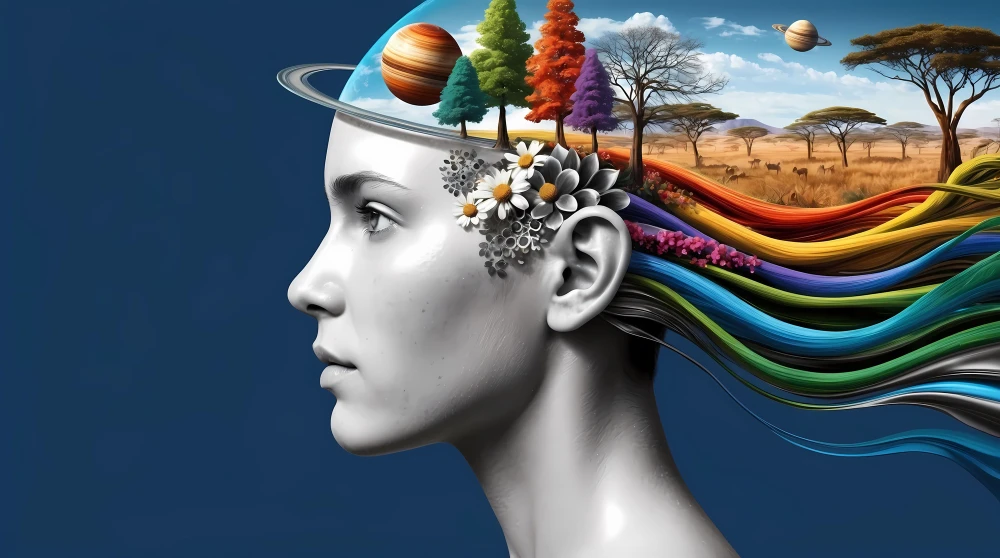
Is the Machine Becoming a Ghost? Human Creativity in the Age of AI
Recently, the rapid development of artificial intelligence (AI) has begun to exert a transformative influence over fields once believed to belong exclusively to human intellect and creativity. The study of literature, for example, now faces profound existential questions. Although AI systems can generate various forms of text, imitate complex literary styles, and analyse vast linguistic datasets, they lack the emotional depth, cultural consciousness, and imaginative intentionality that define human authorship.
This raises a compelling question: Is the machine becoming a ghost, haunting and threatening the human empire of imagination?
AI in Art, Literature, and Creative Production
AI has undeniably achieved remarkable progress in creative domains such as art, music, and literature. Algorithms can produce paintings, compose harmonically structured music, and generate fictional narratives. A notable example is the AI-generated portrait Edmond de Belamy, which sold for $432,500 at Christie’s auction house, sparking debate about authorship and originality (Chok, 2018). Despite its commercial success, however, the portrait lacks the intentional depth and historical consciousness that characterize the masterpieces of Leonardo da Vinci. While AI demonstrates technical sophistication, human creativity remains rooted in lived experience, emotion, and cultural memory. As Boden (2004) explains, creativity involves the generation of ideas shaped by implicit knowledge and complex cognitive processes that extend beyond computational procedures.
Human–AI Collaboration in Creative Processes
Nevertheless, the relationship between humans and machines need not be adversarial. Rather than replacing originality, AI can function as a collaborative tool. Goodfellow et al. (2014) illustrate how co-creative systems such as Generative Adversarial Networks (GANs) enable innovative forms of artistic production. These systems demonstrate that AI can augment human imagination by expanding aesthetic possibilities and accelerating experimentation. Such interaction opens new frontiers in artistic expression and problem-solving.
Limitations of Artificial Intelligence in Creativity
Yet even within collaborative frameworks, the limitations of AI remain evident. Despite its computational power, AI lacks genuine contextual understanding and embodied experience. Clark (2016) argues that intelligence grounded in prediction and data processing does not equate to full comprehension of the world. Human creativity, by contrast, emerges from cultural, social, and personal realities that shape meaning and interpretation. These dimensions are not easily reducible to algorithms.
Developing Human Skills in the Age of AI
To ensure that human creativity remains relevant in the age of AI collaboration, emphasis must be placed on developing complementary human capacities. First, education should prioritize human-cantered design and ethical responsibility, ensuring that technological applications remain socially meaningful and morally accountable. Second, advanced interpretive and reflective skills must be cultivated, particularly in the humanities, where meaning-making and symbolic analysis sustain intellectual depth. Third, interdisciplinary integration between technology, arts, and social sciences should be encouraged to foster critical engagement with AI systems rather than passive reliance on them. Finally, the development of strategic judgment and complex decision-making is essential. As Brynjolfsson and McAfee (2014) suggest, the future of work increasingly rewards non-routine cognitive abilities, creativity, and social intelligence—areas in which humans retain a decisive advantage.
Conclusion
The rise of AI in creative fields does not signal the disappearance of human imagination. Instead, it challenges humanity to redefine its creative role. Machines may simulate artistic forms, but they do not possess consciousness, responsibility, or lived experience. By cultivating ethical awareness, interpretive depth, interdisciplinary knowledge, and complex judgment, humans can reposition themselves not as competitors of AI but as its conscious directors. In doing so, the so-called “ghost” of the machine becomes not a destroyer of creativity, but a promoter for its development.
References:
- Boden, M. A. (2004). The creative mind: Myths and mechanisms (2nd ed.). Routledge.
- Brynjolfsson, E., & McAfee, A. (2014). The second machine age: Work, progress, and prosperity in a time of brilliant technologies. W. W. Norton & Company.
- Chok, D. (2018). AI-generated art sells for $432,500, raising questions about authorship. The Verge.
- Clark, A. (2016). Surfing uncertainty: Prediction, action, and the embodied mind. Oxford University Press.
- Goodfellow, I., Pouget-Abadie, J., Mirza, M., Xu, B., Warde-Farley, D., Ozair, S., Courville, A., & Bengio, Y. (2014). Generative adversarial networks. arXiv preprint arXiv:1406.2661.