
Agentic Logistic: A2A Protocol Trends
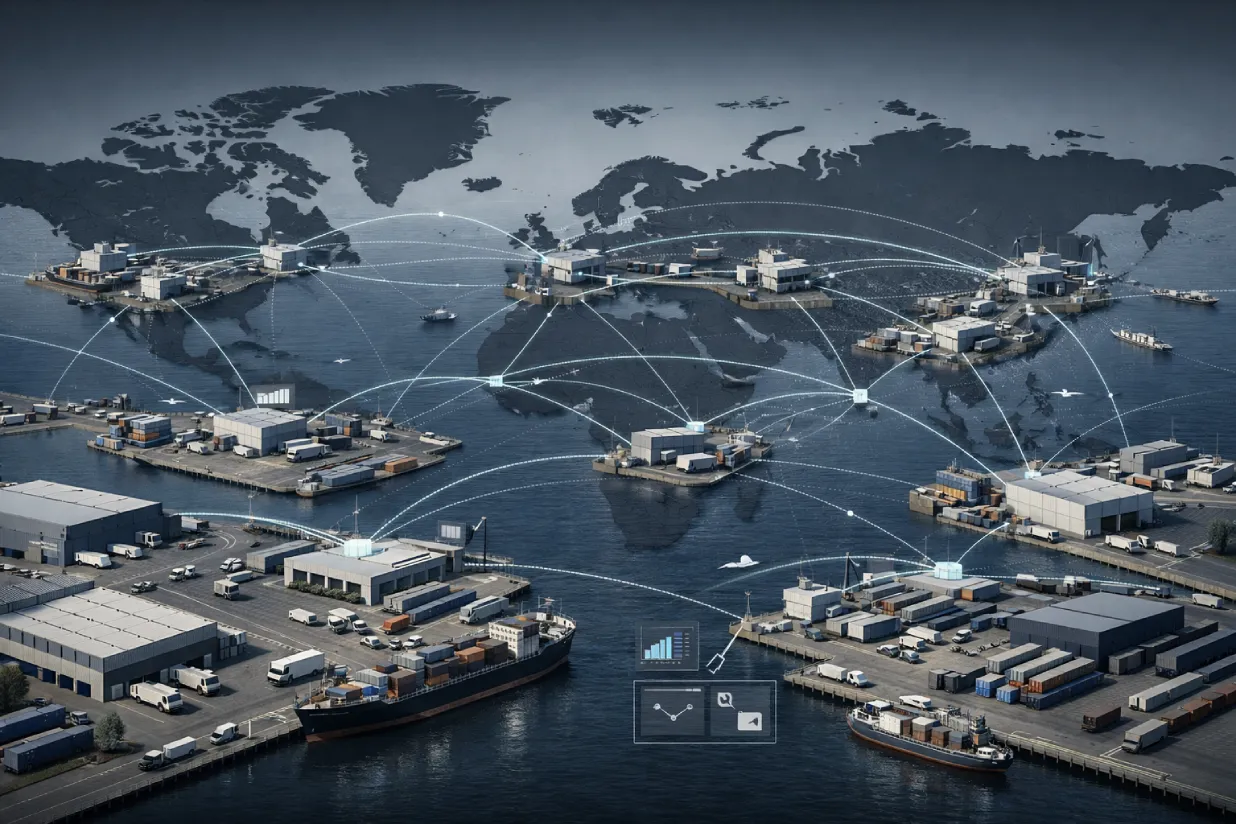
The accelerated growth of the recent known as autonomy logistics ecosystems demonstrates a paradigm shift whereby the stagnant, pre-structured API frameworks are replaced by the dynamic Agentic Mesh basing on the Agent-to-Agent (A2A) protocol standardization.
The independent AI agents in the emerging 2026 logistic and operational landscape, those of shippers, third-party logistics (3PL) providers as well as those of carriers, communicate with each other using advanced Model-to-Model (M2M) communication without requiring a human middleware.
Although the previous versions of the supply chain automation implied the strict usage of scripts or manual input of information, the switch to the agentic systems enables the true independent decision-making within the limited spheres such as the scheduling, the dispatch, and the real-time commercial negotiation.
Thess shift is not only a technical upgrade but a new change whereby the supply chain becomes a self-organizing system, that is capable of responding to environmental fluctuations on machine speed (Janelli, et al., 2025).
Model Context Protocol (MCP) and A2A Communication
The key element of this change is the Model Context Protocol (MCP), which serves as a universal interface that we can refer to it as a USB-C port to AI, and standardize the interface to access enterprise data and logistics tools.
Thus, MCP is used by individual agents to communicate with the internal resources such as the Warehouse Management Systems (WMS), the Transportation Management Systems (TMS) or the real-time telemetry, the A2A protocol offer the necessary horizontal coordination layer of secure and cross-organizational delegation.
These systems can discover dynamic capabilities by using the standardized "Agent Cards" and JSON-RPC messaging. This enables the agent of a shipper to recognize, confirm and bargain with different carrier agent at the same time or in real-time in accordance with their promoted execution indices, area reach and real-time service points (Gonzalez-Cancelas, et al., 2025).
Autonomous Negotiation and Self-Healing Supply Chains
The main practical implementation on this mesh is autonomous negotiation of spot rates in not stable freight markets. In contrast to conventional automation where follow linear logic, agentic systems are based on deep reinforcement learning and game theory to optimize the complex trade-offs between speed, cost and sustainability objectives of delivery.
The agentic mesh is used to achieve a self-healing supply chain when disruptions take place, e.g., delays in ports, equipment breakdowns or severe weather. In such cases, a logistics agent may independently run a mini-bid procedure through the A2A protocol, requesting quotes among carrier agents which are available and rerouting shipments within milliseconds to keep service level commitments.
The practice transforms the industry of human-based exception management to an autonomous execution model that can enhance the cost very good efficiency (Ayyagari, 2025).
Governance, Scalability, and Ethical Protocols
When the ecosystems scale toward 2026, it also considers the multi-dimensional issue of bidirectional connections, which is quadratic due to the possibility that more participants can be added to the network.
To deal with this, fashion trends lean towards a layered architecture that integrates the Model context Protocol (MCP) to interact with tools and the A2A protocol to interact horizontally.
These autonomous agents are bound by strictly clear financial and ethical guidelines, which is guaranteed through the integration of the so-called Governance-as-Code. Such as spend limits, verified certificate checks, and ESG compliance protocols, which are validated at runtime and by the orchestration fabric which prevent "hallucinated" transactions or unauthorized expenditures.
This will result in a strong, transparent, and very efficient logistics network that will substitute normal operations with good integrations and with flexible and agentic partnerships (Hou, et al. 2025).
References:
- Jannelli, V., Schöpf, S., Bickel, M., Netland, T., & Brintrup, A. (2025). Agentic LLMs in the supply chain: towards autonomous multi-agent consensus-seeking. International Journal of Production Research, 1–31. https://doi.org/10.1080/00207543.2025.2604311
- González-Cancelas, N., Vaca-Cabrero, J., & Camarero-Orive, A. (2025). Multi-Agent System for Smart Roll-on/Roll-off Terminal Management: Orchestration and Communication Strategies for AI-Driven Optimization. Applied Sciences, 15(11), 6079.
- Ayyagari, V. (2025). Model Context Protocol for Agentic AI: Enabling contextual interoperability across systems. International Journal of Computational and Experimental Science and Engineering, 11(3). https://doi.org/10.22399/ijcesen.3678
- Hou, X., Zhao, Y., Wang, S., & Wang, H. (2025). Model context protocol (mcp): Landscape, security threats, and future research directions. arXiv preprint arXiv:2503.23278. https://doi.org/10.48550/arXiv.2503.23278