
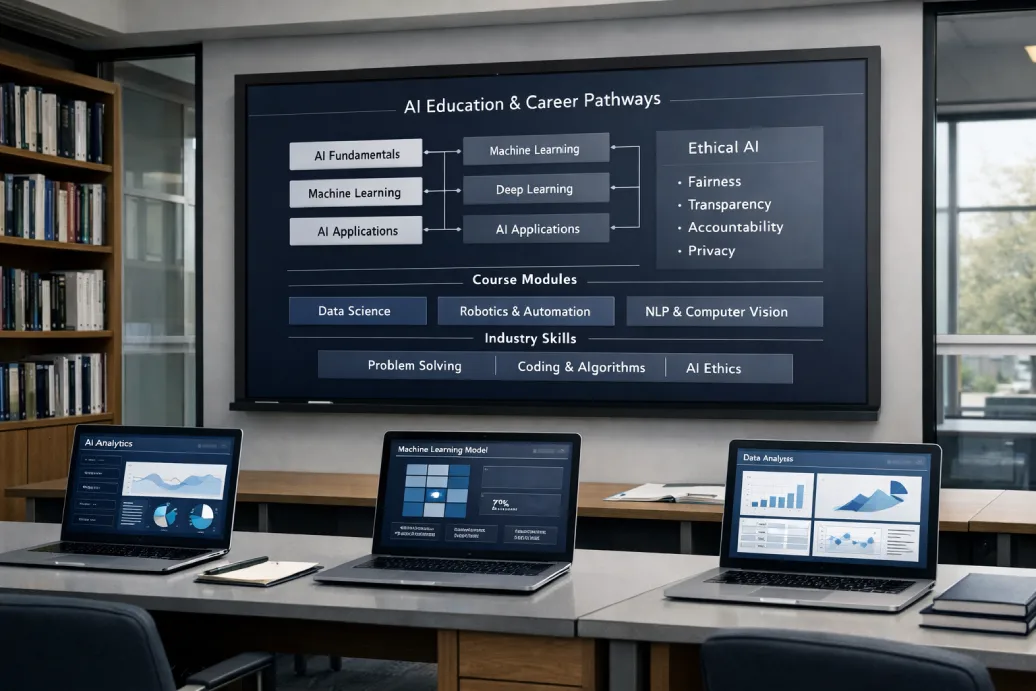
The Role of Universities in the AI-Driven Workforce
Artificial intelligence (AI) is transforming every aspect of modern life, from workplaces to classrooms, placing universities under immense pressure to evolve. The traditional model of Higher Education, focused on theoretical knowledge and rigid degree structures, must now embrace innovation, speed, and adaptability.
The workforce of the future will be shaped by AI, and graduates must be ready (Association for Women in Science, 2024).
Why AI Is Redefining the Job Market
Across industries, AI automates routine tasks, streamlines decision-making, and creates new roles that did not exist a decade ago. Employers now demand critical thinking, adaptability, digital literacy, and collaboration with intelligent systems (Nexford University, 2024). In many sectors, AI is not just a tool—it is a co-worker.
Graduates must therefore understand how AI works, apply it responsibly, and contribute uniquely as humans—offering judgment, creativity, emotional intelligence, and ethical reasoning (Nature Humanities and Social Sciences Communications, 2025).
How Forward-Thinking Universities Are Responding
Universities worldwide are transforming curricula, teaching methods, and partnerships to meet these demands (Communications of the ACM, 2023). Key shifts include:
- AI Across Disciplines: AI is embedded into business, healthcare, law, and education, ensuring students across fields understand its impact.
- Foundational AI Courses: Many institutions now require all undergraduates to take at least one course in AI or data literacy.
- Hands-on Learning: Partnerships with tech companies and research labs provide students with practical exposure through internships, projects, and simulations.
- Focus on Ethics: Courses on algorithmic bias, digital ethics, and data privacy help students understand the social consequences of technology.
- Use of AI in Teaching: Smart learning platforms, AI-driven assessments, and intelligent tutors enhance learning experiences and personalize education (University of St. Augustine for Health Sciences, 2023).
Skills Students Must Develop for the AI Era
The AI-driven workforce requires a balanced, human-centric approach (Learning Policy Institute, 2023):
- Digital and AI Literacy: Students must interpret AI outputs and apply tools like ChatGPT, IBM Watson, and adaptive learning platforms.
- Adaptability and Lifelong Learning: With AI evolving rapidly, universities increasingly offer micro-credentials and bootcamps to support continuous upskilling.
- Critical Thinking and Creativity: AI cannot replicate human curiosity; universities encourage innovation through hackathons and research labs.
- Communication and Collaboration: Interdisciplinary teamwork is emphasized, especially in environments where humans and AI co-exist.
- Ethical Judgment and Social Awareness: Students are trained to evaluate the moral and social impact of AI decisions, particularly in sensitive fields like healthcare and justice.
Barriers to Change
Despite progress, challenges remain
- Slow Curriculum Reforms: Universities often lag behind industry needs (ResearchGate, 2024).
- Lack of Infrastructure: Not all institutions have advanced AI labs or faculty expertise.
- Academic Integrity Concerns: Generative AI tools complicate student assessment.
- Equity and Access Issues: Students from less privileged backgrounds risk exclusion from AI opportunities.
The University of the Future
To prepare students for AI-transformed industries, universities must reimagine their role (Hechinger Report, 2024):
1. Dynamic and Modular Learning: Flexible programs allow students to combine AI with ethics, design, or sustainability.
- Tools: NotebookLM (Google’s AI note-taking assistant) helps students organize modular learning content across disciplines.
- Claude (Anthropic) supports long-context reasoning, making it ideal for interdisciplinary projects that blend AI with the humanities.
- Canvas LMS integrates modular AI ethics courses alongside technical training.
2. Lifelong Learning Hubs: Universities extend education beyond four-year degrees through micro-credentials and refresher courses.
- Tools: ChatGPT provides personalized tutoring and refresher explanations for alumni taking short AI bootcamps.
- LinkedIn Learning issue digital badges for AI skills, visible to employers.
- DeepSeek (open-source AI) can be used in lifelong learning hubs for advanced research simulations and coding practice.
3. AI-Empowered Teaching: Smart assessments and adaptive platforms personalize education for diverse learners.
- Tools: Microsoft Copilot in Education assists instructors with lesson planning, grading, and content creation.
- Gradescope (AI-assisted grading) speeds up evaluation of assignments.
- Manus (AI writing assistant) helps students refine essays while maintaining academic integrity.
- Knewton Alta adapts coursework to each student’s pace.
4. Industry and Government Collaboration: Universities co-design curricula with tech firms and policymakers to ensure relevance.
- Tools: Claude can analyze policy documents and assist in curriculum co-design.
- IBM SkillsBuild and AWS Academy provide industry-grade AI labs and certifications.
- ChatGPT Enterprise supports collaborative curriculum development with industry partners.
5. Inclusive and Ethical Models: Ensuring AI education is accessible and socially responsible.
- Tools: AI Fairness 360 (IBM) helps students understand bias in algorithms.
- DeepSeek provides open-source AI models, ensuring accessibility for institutions with limited budgets.
- NotebookLM supports accessibility by organizing diverse learning materials into structured summaries.
- Claude emphasizes safety and ethical reasoning, aligning with responsible AI education.
Conclusion
The role of universities has never been more urgent. The AI-driven transformation of the global economy is inevitable, and whether it is inclusive and ethical depends largely on how we educate the next generation. Universities must not only teach students how to survive in an AI-powered world, but how to shape it for the better (Federal Reserve Bank of Atlanta, 2024).
References
- Association for Women in Science. (2024). How universities are preparing students for the future of AI.
- Communications of the ACM. (2023). Is higher education ready for AI?
- Learning Policy Institute. (2023). Educating in the AI era.
- Nature Humanities and Social Sciences Communications. (2025). The human-AI collaboration.
- Nexford University. (2024). How AI will affect jobs.
- Federal Reserve Bank of Atlanta. (2024). Employer demand for AI skills.
- University of St. Augustine for Health Sciences. (2023). AI in higher education.
- The Hechinger Report. (2024). AI skills beyond tech majors.
- ResearchGate. (2024). Higher education in AI-driven careers.